
The game shall be known as 8 Ball Pool and shall be played in the true spirit of the game and in a sportsmanlike manner. It should be clearly understood that the referee is the sole judge of what is legal or illegal play. The referee will take whatever action necessary to ensure that these rules are observed.
The game is played on a 6-pocket table with 15 object balls plus a cue ball. Object balls are comprised of groups of 7 balls (communally known as spots and stripes) plus a black ball (the 8 ball).
The player, or team, pocketing all of one group of object balls in any order, then legally pocketing the 8 ball, wins the game. The player playing the black ball must nominate which pocket he/she is going for.
- Single matches The match consists of 4 groups in total. 3 Groups of 4 singles games and 1 group of 3 singles (15 in all). The same players cannot play against each other until the last group of games.
- Scotch doubles The match consists of 4 groups in total. 3 Groups made up of 2 singles games and 1 game of scotch doubles, and 1 group of 4 singles No player can play singles in all 4 groups. He can however play 3 singles and 1 doubles game. A player must play at least 1 doubles game to be able to play in the last 4 singles games. It is therefore necessary to have at least 4 players per team. In the singles games no two players can play against each other a second time in the first 3 groups, they can however meet again in the 4th group. In scotch doubles team members alternate shots every time. Doubles partners can confer at all times.
-
The balls are racked with the 8 ball (black) on the spot, which is at the intersection of the centre line of the table and the point mid-way between the side and corner pockets of the foot of the table) and in the fashion of the picture below. Stripes and spots may be
interchanged.
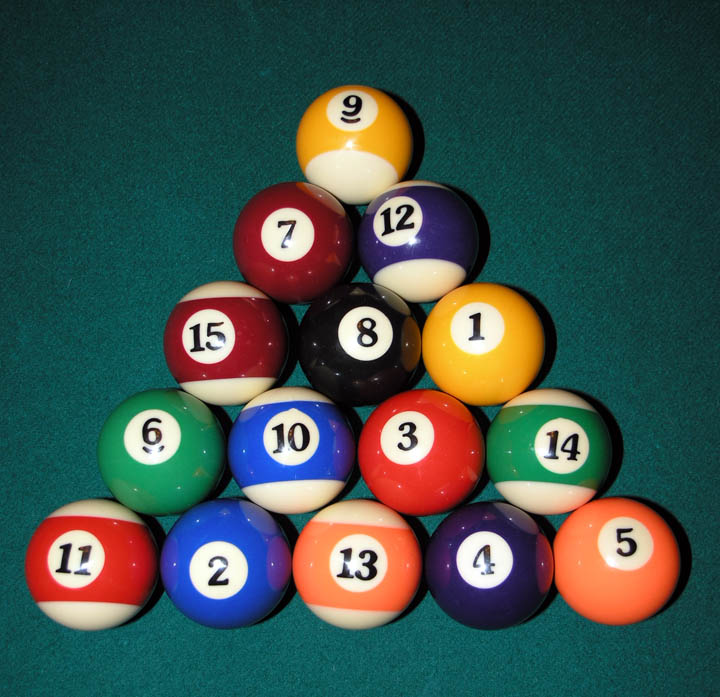
- Order of play is the home team breaks in the first game and thereafter alternating the break between the teams.
- The opening player shoots at the triangle of object balls by striking them with the cue ball from any position on, or behind the balk line at the head of the table. An object ball must be pocketed or at least TWO object balls hit any cushion. Failure to do so is a foul break. The incoming player has the option of playing one shot ball in hand with an open table with the previous break shot remaining on the table or having the balls re-racked, with the option of breaking or not breaking the new rack.
- If the 8 ball (black) is pocketed from the break shot, the balls will be re-racked and the same player will restart the game. No penalty will be incurred. This applies even if other balls, including the cue ball, are pocketed, or leave the playing surface (off the table).
- On the first occasion a player legally pockets an object ball the player can decide if they want spots or stripes. If one or more of both groups of balls are pocketed the table remains open in which case the next object ball that is hit becomes that players group unless a foul has been committed in which case the table remains open.
- If no object ball is pocketed from a legal break then the players continue playing alternately at either group until such a time as a legal pot is made which then denotes that players group.
- If a foul is committed (other than as in rule “d”) and one or more object balls are pocketed before playing groups have been decided then those balls are ignored in determining a players group. The incoming player then has one shot ball in hand, open table with all balls neutral (including the 8 ball). The first legally potted ball then determines the players group as in rule “e”.
-
If a ball (or balls) is legally pocketed, this entitles the player to one additional shot and
this continues until the player either :
1. Fails to pocket one of their own set of allocated balls.
2. Commits a foul at any time - Combination shots are allowed providing the player hits one of their own group first with the exception of the ball in hand rule on a foul shot when all balls can be legally struck.
- Cue ball is pocketed at any time.
- Hitting an opponent’s ball with the cue ball prior to contact of players own group. Except when player receives foul shot ball in hand as in “a”.
- Failing to hit any ball of the players group with the cue ball.
- Jump shot. Defined as when the cue ball jumps over any part of any ball before making contact with any other ball.
- Hitting the 8 ball with the cue ball on first impact before their group ball is legally potted.
- Potting any opponent’s ball.
- Any ball leaves the table. Should a ball leave the table it is replaced on or as near to the black 8 ball spot in a direct line down the centre of the table towards the baulk area. Should the 8 ball leave the table when that is the only ball left that player loses the game.
- If a player’s body, clothing or hair should touch any ball
- Player not having at least part of one foot on the floor.
- Playing or touching with the cue any ball other than the cue ball.
- Striking the cue ball with any part of the cue other than the tip.
- Playing out of turn.
- Playing before all balls have come to rest.
- Playing before any ball(s) that require re-spotting have been re-spotted.
- Striking the cue ball with the cue more than once.
- Foul break. Defined as failing to pot an object ball or drive at least two object balls to hit any cushion.
- Taking a phone call while competing in a game whether in control of the table or not.
- Coaching is considered unsportsmanlike behaviour. If the referee decides that coaching has occurred (by any word or action from other team members/spectators that couldn’t be considered to be normal support or barracking) the referee shall issue a first and final warning. If coaching reoccurs the player will be penalized via a standard foul.
- Following any foul the offending players visit is finished and their opponent may, without nomination, play the cue ball onto any ball without penalty including any of the opponent’s ball(s) or the 8 ball. If any object ball(s) is pocketed directly or by combination the player is deemed to have pocketed a ball legally and continues with the visit. However, the player must not pot the 8 ball which would mean loss of game, except if the player is on the 8 ball which would result in a win. When the player fails to pot a ball on this visit it becomes their opponents turn.
- The incoming player has the option of playing the cue ball where it comes to rest from the foul committed or ball in hand rule. It is advised to ask the referee to hand them the cue ball eliminating the possibility of committing a foul.
- A player cannot play a snooker by rolling up behind 1 of their balls. Any ball must make contact with a cushion to play a legal snooker. Ball in hand rule is awarded.
- If a player pockets the 8 ball before all the balls in their own group have been legally potted. Exception: Pocketing the black ball from the commencement (the break) of the game.
- A player pocketing the cue ball along with the 8 ball when the 8 ball is their object ball.
- A player pocketing the 8 ball and any other ball on the same shot will lose the game. Exception: following a foul when only the 8 ball and any ball(s) of the opponents group are on the table then the player may legally pocket the 8 ball as well as any of the opponents group by any combination and in any order.
- A player who takes a second phone call during a game will lose the game.
- If the player is on the 8 ball and pots the 8 ball along or simultaneously with an opponent’s ball.
-
Touching ball :
1. When the cue ball is touching an opponent’s ball or the 8 ball the player must play away from the touching ball and contact a ball of his own group. The Referee is not required to call a touching ball but the object ball which the cue ball is touching must not move during the shot. If it does then this is a foul.
2. When the cue ball is touching a ball of his own group the player is legally entitled to play away from the touching ball and is deemed to have played that ball. In this manner if the cue ball strikes or fails to strike any other ball it is deemed a legal shot (no foul). In this case the referee must call and identify the touching ball.
- Ball in hand. When a player can place the cue ball anywhere on the table and play in any direction and strike any ball on the table.
- If the player pots a ball it is deemed legal and continues with their visit to the table.
- Player in control. A player is said to be in control of the table from the time their body, clothing or cue stick comes in contact with the table prior to their actual shot and continues throughout the visit until the opponent does likewise to begin their visit. Any ball(s) which fall into pockets during this period including the 8 ball are said to have been potted by that player and are liable to any penalties or benefits normally awarded to them as the result and are accorded to them in the rules of the game.
- Completion of game. The game is completed when a player has pocketed their group of balls and the 8 ball is pocketed in a legal manner. Exceptions are when the 8 ball has been illegally pocketed ending the game or on the break. After a player has pocketed all balls of their set, they must then pocket the black ball. Before shooting for the black ball, the referee will ask the player to first nominate which pocket he intends to shoot the black ball into. After the player nominates the pocket, they must shoot the black into that pocket. If the player pockets the black into the pocket that they nominated, they win and the game is over. If the player pockets the black ball into a pocket other than the nominated pocket, they lose and the game is over. If the player does not pocket the black ball it becomes the opposing players turn.
Should any situation arise where by a legal shot is impossible to play, then the game shall be restarted by the player who started that frame whether this situation has been arrived at by accident or design. If in the opinion of the referee, neither player is allowing the game to progress or a stalemate situation has arisen then the game shall be restarted by the player who started that frame. The referee shall not allow numerous visits with neither player making any attempt to make the opening pot which decides the playing groups (unless it is felt that progress is being made).
If the player who started that frame did so by virtue of their opponent making a foul break that player will break on any restart, not the opponent who made the foul break.
- Striking the cue ball with a cue stick once.
- A player taking a turn at the table which may comprise of one or more shots.
- A referee, if requested, should be the only person allowed to give advice on the rules of the game.
- A player who in the opinion of the referee is taking too long to play a shot shall be given a first warning. If a second warning or subsequent warning needs to be given the player will be penalised as a foul and the incoming player shall be awarded ball in hand. If in the referee’s opinion a player is infirm then allowance should be made.
These rules are the EPA (English Pool Association) Rules with a few minor amendments to make them more relevant to local playing circumstances.
The following notes are to clarify a few rules which sometimes cause problems.
- Touching ball. When the cue ball is touching another ball the player must play away from the touching ball. Playing away is considered to be playing away at such an angle that the touching ball is not disturbed. If the touching ball moves because of contact with the ball, it is a foul shot. If the touching ball moves and the referee decided that it moved by means outside of the control of the player (for example an imperfection in the table) he may rule that it is not a foul.
- Players should turn off their mobile phones or hand them to someone else before a game commences. A player who answers a phone during a game, whether at the table or not will have committed a foul shot or for a second offense in the game will lose the game.
- Unless specifically asked by the player, the referee is not permitted to offer advice even if the referee thinks the player may be about to play a foul shot.
- No player can take part in the game if they are more than 30 minutes late after the 1st game has started.
- The home team is responsible for supplying referees, and it should be noted that said individual takes full notice of the proceedings, in order that they can give an accurate ruling on any given situation.
-
There is a minimum of 4 players per team. If less than 4 players, then it is the captains of both teams to come to a solution. But it is recommended that the captain decides who plays more than once from the team with not enough players. If it is the home team that doesn’t have enough players, then they can use 1 of the girls working in that bar.
A minimum of 2 European/Australian/American (non-Asian males/ladyboys) must play in every set. A team can use female staff from a bar to fill in for non- Asian male/ladyboy players. - Only 2 male Thai players are allowed to play in each set. A ladyboy is classed as a male.
AGM 17-11-2024
-
The following rule supersedes rule on page 6 of the "Rules of the Game" under "Additional Notes" rule 7, and will take effect as from 5th January 2025. This will cover Monday, Wednesday and Sunday leagues.
A minimum of 2 European/Australian/American (non-Asian males/ladyboys) must play in every set. A team can use female staff from a bar to fill in for non- Asian male/ladyboy players. - The following rule is an addition/change to rule on page 2 of the "Procedural Rules" under "Match Arrangements" rule 2c. Any match cancelled with/without 24hrs notice, must be played within 2 weeks of the original play date. Both team captains must notify a member of the committee within the original start time. If the match isn't played within the 2 weeks, then the score will be 8-7 awarded to the team that didn't cancel to original match.