Procedural & Playing Rules - East Pattaya Pool Leagues
1. Introduction
These Procedural Rules are to be read in conjunction with the latest set of Rules of the Game: Playing Rules revised February 2024 issued to all bars that have teams.
Any team who have not received a set of relevant rules should notify a member of their committee immediately and arrange to obtain a set.
This set of Procedural Rules are designed to help all referees and teams to fully understand and implement a standard of fair play to which everyone can comply.
In accordance with the Rules of the game: Playing Rules for these leagues should be played in a sportsmanlike manner and due courtesy extended to the Referee and other team players at all times.
It may well be that minor infringements of the rules can occur and it is expected that the respective team captains should attempt to resolve the infringement in an amicable way.
In the event that a solution can not be reached then these rules shall be implemented to the letter.
ALL TEAM CAPTAINS, BAR OWNERS AND PLAYERS SHOULD FAMILIARISE THEMSELVES WITH THESE PROCEDURAL RULES AND THE RULES OF THE GAME: PLAYING RULES.
2. Team and match format
- Any seasonal registration fee and team deposits will be decided at each League AGM and collected by the Official responsible and must be paid prior to the commencement of the season by the Bar owner or Team Captain.
- The requirement for a suitable venue is a standard, well maintained, seven, eight or nine foot pool or snooker table with good quality accessories, namely at least two good cues, a standard X rest, a high spider rest (not a square rest), a good table light and a set of decent shiny pool balls and the table should be in a clean and presentable condition.
- All teams must provide at least one name and phone number where the team can be contacted without too much trouble when necessary. In addition, an email address would also be useful. Teams who have not provided this information will be responsible for any consequences of them not being contactable.
- The match format is specified in the Playing Rules for individual Leagues.
- Members of any team may only change the team they play for one time per season without waiting 2 weeks, and may not even return to their original team until the following season. Any team who have offended this team membership requirement will forfeit the match 15-0.
- No player can transfer to another team with only 4 fixtures remaining. If anybody found to be doing this, the player will be suspended for the rest of the current season and the team will have forfeited the last 4 games of its current season.
3. Match arrangements
- Matches will be played on a home and away basis as per your league fixture list.
- The official match start time is 19.00hrs (7pm) on Monday's/Wednesday's and 17.00 (5pm) on Sundays unless otherwise stipulated within your league or by prior arrangement with your opponents. The table must be made available for the visiting team to practice 30 minutes before match start time.
- No show. If 24 hrs notice is given by a team, this can be done without penalty. Without giving 24 hrs notice this will be considered as no show and they will be responsible for making arrangements for the match to be played as soon as possible. If the said team doesn't show for the rearranged match, then they will lose 15-0.
- Your league committee must be notified of any re-arranged matches within 24 hrs of the original match date.
- All teams should have at least 3 players present and names entered on the playing schedule at the official start time. The full team must be present by 19.00hrs (7pm) Mondays/Wednesdays and 17.00hrs (5pm) on Sundays, and must remain there until such time as the match is completed unless prior arrangement has been agreed by the captains. Players arriving after 30 minutes will not be eligible to play.
- The home team must add their players names to the playing schedule first followed by their opponents. Within reason and with the agreement of both team captains names may be changed after they have been entered on the schedule.
- If for whatever reason a match cannot be completed on the fixture night then it must be completed as soon as possible after, with that night's score being used at the start of the completion session and the final scores being notified to the scorer by both team captains.
4. Referees and match disputes
- The home team must have copies of both these Procedural Rules and the official Playing Rules available in the Bar to settle any disputes.
- The home team must provide competent referees for all games unless agreed otherwise by both captains. The referee must be a team player or bar owner who understands the rules. In either case the referee must pay close attention to the game in hand at all times. This means that the referee must position themselves, so that they can see everything happening in the game. Failure to provide a referee for all games without both captains agreement will result in the away team claiming the match. In the event of a playing dispute, the referee's decision will be final. If a player disagrees with the referees judgement call there are no grounds for a formal complaint and the referee's decision is final.
- A dispute of any kind is no reason for a match to be abandoned. The match must be completed and the dispute referred to the committee for their consideration. Any team refusing to complete a game or match because of any dispute will forfeit the match.
- Any dispute which requires the committee's attention must be registered within 24hrs of the match completion. No dispute will be considered by the committee if a referee has not overseen the game where the dispute arose. The committee will then meet at their earliest convenience and decide on the course of action and notify both teams.
- Unsportsmanlike behaviour will be decided by the referee and will incur a first and a final warning for the first offence with a second act of unsportsmanlike behaviour being penalised by the loss of game. Moving into or across or failing to move out of the opponents direct line of vision will be considered unsportsmanlike behaviour. Reaching to the table to obtain chalk and touching the table during your opponents visit will also come under this heading and the same warning will be given by the referee. Please keep away from the table until it is your turn to play. No comments should be directed towards a player when he is playing. Excessively loud vulgar language will not be tolerated as this could offend other patrons of the bar and warnings and fouls will be issued. Aggressive, threatening or violent behaviour by any team member towards the referee or any other team member or Committee member will not be tolerated within this league and will be dealt with severely by the committee. No first and second warnings, this behaviour is an absolute NO NO. Look forward to a total team and bar ban from this and other leagues. This is supposed to be a fun night out. The payment to any player is also a NO NO the league is run as social and armature evenings, paying any player will be seen upon as a professional and the committee will not let this happen. If any team is caught or found to be paying any player they will be dealt with as the committee sees fit. This can mean a suspension for the bar, owner or player. Depending on the severity of the case it can mean a total ban for the bar, owner or player(s).
5. Reporting of results
- In all leagues. The home team is responsibility for a correct photo and score. When a bad photo is uploaded the home team get 2 penalty points. The away team can send in a decent photo until 7 PM the next evening, i.e. within 24 hours. You will not be prompted to do this by anyone from the committee. So it's important to always take a picture for yourself and check the uploaded photo from the home team. When there is no correct photo send by 7 PM the following day the away team will also get 2 penalty points. A vote on this was held on September 15, 2026.
- It is not the responsibility of the committee to have to chase outstanding results.
- The league standings will be updated on our pool league app.
- All results must come with photographic evidence of the scoreboard.
6. The championship
- The match winning team will be awarded two league points depending on which league and the losing team zero points. A bye will be scored 15-0 and a match involving a no show or forfeit, the offended team will be awarded a 15-0.
- Positions in the league standings will be decided on league points. If there is a tie on points, then the positions will be decided on the best game difference i.e. Games won and games lost. If a tie still remains then the standings will be decided on frame difference i.e. Frames won against frames lost.
- If league positions are still tied after having applied the above rules and it has a bearing on who will be awarded trophies then the teams involved will play off as described below.
- If a playoff is required for any reason it will be a single match played under normal league conditions at a mutually agreed venue.
- Trophies will be awarded to the winner and runner up teams.
7. End of season party
A party is held at the end of each season for each league in one of the league team's bars.
8. Rule Changes / Amendments
AGM 17-10-2026
Amendment to the Procedural Rules
Rule: Professional Player Eligibility and Participation
-
Prohibition of Professional Players
The participation of professional pool players in the East Pattaya Pool League (Darkside) is strictly prohibited. All players representing a team must comply with the league's player eligibility requirements. -
Definition and Establishment of Professional Player Status
For the purposes of these rules, a professional pool player is a person who meets one or more of the following criteria:- Currently earns income, prize money or other financial compensation through playing pool as a professional activity. (Not the Killer pool tournaments organized in bars.)
- Regularly participates in professional pool tournaments, professional circuits or competitions specifically designated for professional players.
- Holds or has held a recognised professional pool ranking, professional player status, or membership in a professional pool organisation.
- Is publicly identified or promoted as a professional pool player by a recognised tournament organiser, professional pool organisation or other credible source.
- Has a documented history of competing at professional level, supported by verifiable tournament records, published results, player profiles or other credible evidence.
The League Committee may also consider other relevant evidence when assessing whether a player should be classified as a professional player under these rules.Participation in amateur tournaments, possession of strong playing ability, or winning local league competitions alone shall not automatically constitute professional status. -
Responsibility for Player Eligibility
The bar owner and/or team captain is responsible for taking reasonable steps to verify the eligibility of any player selected to represent their team.
Such checks must be carried out before the player participates in a league match. By selecting and fielding a player, the bar owner and/or team captain accepts responsibility for ensuring that the player complies with these rules. -
Investigation and Assessment by the Committee
The League Committee reserves the right to investigate any player suspected of being a professional pool player.The committee may use publicly available information and other credible evidence, including:- Social media profiles, posts, photographs and videos.
- Professional tournament participation and results.
- Official rankings and player profiles.
- Records published by tournament organisers or professional pool organisations.
- Other verifiable information relevant to the player's professional status.
Where a player's status is disputed, the player and the team concerned should be given a reasonable opportunity to provide an explanation or supporting evidence before a final decision is made. -
Consequences of a Breach
If the committee determines that a player is ineligible under this rule, that player will not be permitted to participate in the league.The consequences for the player, bar owner, team captain and/or team will be determined by the League Committee and established in a separate disciplinary provision or subsequent amendment to the procedural rules.Any disciplinary measures should be applied consistently and proportionately, taking into account the circumstances of the breach and whether it was deliberate or repeated. -
Committee Authority and Consistency
The League Committee is responsible for interpreting and applying this rule and assessing disputed cases based on the available evidence.All cases must be handled fairly and consistently across participating teams. Decisions and any resulting disciplinary measures should be documented and communicated to the parties concerned. -
Effective Date
This amendment will take effect from the date approved by the League Committee and communicated to all participating bars and teams.
AGM 17-11-2024
-
The following rule supersedes rule on page 6 of the "Rules of the Game" under "Additional Notes" rule 7, and will take effect as from 5th January 2025. This will cover Monday, Wednesday and Sunday leagues.
A minimum of 2 European/Australian/American (non-Asian males/ladyboys) must play in every set. A team can use female staff from a bar to fill in for non- Asian male/ladyboy players. - The following rule is an addition/change to rule on page 2 of the "Procedural Rules" under "Match Arrangements" rule 2c. Any match cancelled with/without 24hrs notice, must be played within 2 weeks of the original play date. Both team captains must notify a member of the committee within the original start time. If the match isn't played within the 2 weeks, then the score will be 8-7 awarded to the team that didn't cancel to original match.
1. The game
The game shall be known as 8 Ball Pool and shall be played in the true spirit of the game and in a sportsmanlike manner. It should be clearly understood that the referee is the sole judge of what is legal or illegal play. The referee will take whatever action necessary to ensure that these rules are observed.
2. Requirements of the game
The game is played on a 6-pocket table with 15 object balls plus a cue ball. Object balls are comprised of groups of 7 balls (communally known as spots and stripes) plus a black ball (the 8 ball).
3. Object of the game
The player, or team, pocketing all of one group of object balls in any order, then legally pocketing the 8 ball, wins the game. The player playing the black ball must nominate which pocket he/she is going for.
4. Format of the game
- Single matches The match consists of 4 groups in total. 3 Groups of 4 singles games and 1 group of 3 singles (15 in all). The same players cannot play against each other until the last group of games.
- Scotch doubles The match consists of 4 groups in total. 3 Groups made up of 2 singles games and 1 game of scotch doubles, and 1 group of 4 singles No player can play singles in all 4 groups. He can however play 3 singles and 1 doubles game. A player must play at least 1 doubles game to be able to play in the last 4 singles games. It is therefore necessary to have at least 4 players per team. In the singles games no two players can play against each other a second time in the first 3 groups, they can however meet again in the 4th group. In scotch doubles team members alternate shots every time. Doubles partners can confer at all times.
5. Commencement of the game or re-start
-
The balls are racked with the 8 ball (black) on the spot, which is at the intersection of the centre line of the table and the point mid-way between the side and corner pockets of the foot of the table) and in the fashion of the picture below. Stripes and spots may be
interchanged.
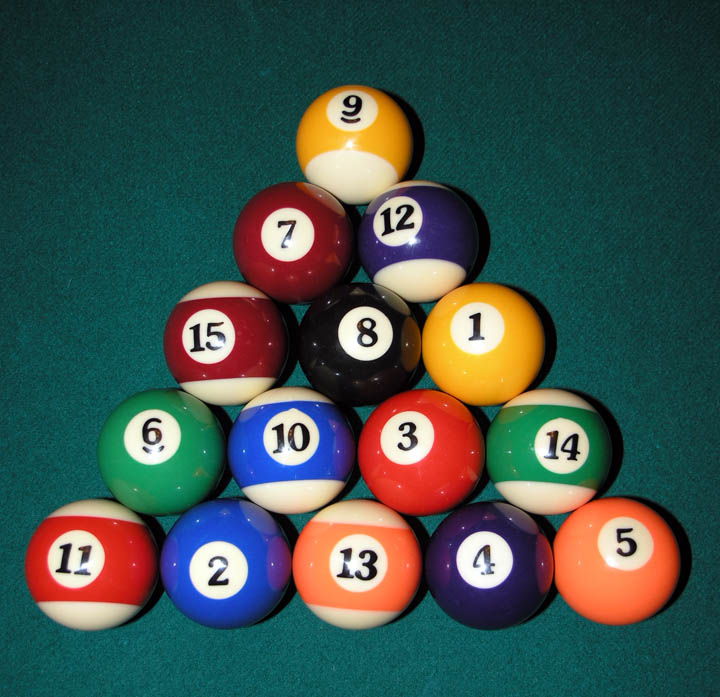
- Order of play is the home team breaks in the first game and thereafter alternating the break between the teams.
- The opening player shoots at the triangle of object balls by striking them with the cue ball from any position on, or behind the balk line at the head of the table. An object ball must be pocketed or at least TWO object balls hit any cushion. Failure to do so is a foul break. The incoming player has the option of playing one shot ball in hand with an open table with the previous break shot remaining on the table or having the balls re-racked, with the option of breaking or not breaking the new rack.
- If the 8 ball (black) is pocketed from the break shot, the balls will be re-racked and the same player will restart the game. No penalty will be incurred. This applies even if other balls, including the cue ball, are pocketed, or leave the playing surface (off the table).
- On the first occasion a player legally pockets an object ball the player can decide if they want spots or stripes. If one or more of both groups of balls are pocketed the table remains open in which case the next object ball that is hit becomes that players group unless a foul has been committed in which case the table remains open.
- If no object ball is pocketed from a legal break then the players continue playing alternately at either group until such a time as a legal pot is made which then denotes that players group.
- If a foul is committed (other than as in rule "d") and one or more object balls are pocketed before playing groups have been decided then those balls are ignored in determining a players group. The incoming player then has one shot ball in hand, open table with all balls neutral (including the 8 ball). The first legally potted ball then determines the players group as in rule "e".
-
If a ball (or balls) is legally pocketed, this entitles the player to one additional shot and
this continues until the player either :
1. Fails to pocket one of their own set of allocated balls.
2. Commits a foul at any time - Combination shots are allowed providing the player hits one of their own group first with the exception of the ball in hand rule on a foul shot when all balls can be legally struck.
6. Fouls
- Cue ball is pocketed at any time.
- Hitting an opponent's ball with the cue ball prior to contact of players own group. Except when player receives foul shot ball in hand as in "a".
- Failing to hit any ball of the players group with the cue ball.
- Jump shot. Defined as when the cue ball jumps over any part of any ball before making contact with any other ball.
- Hitting the 8 ball with the cue ball on first impact before their group ball is legally potted.
- Potting any opponent's ball.
- Any ball leaves the table. Should a ball leave the table it is replaced on or as near to the black 8 ball spot in a direct line down the centre of the table towards the baulk area. Should the 8 ball leave the table when that is the only ball left that player loses the game.
- If a player's body, clothing or hair should touch any ball
- Player not having at least part of one foot on the floor.
- Playing or touching with the cue any ball other than the cue ball.
- Striking the cue ball with any part of the cue other than the tip.
- Playing out of turn.
- Playing before all balls have come to rest.
- Playing before any ball(s) that require re-spotting have been re-spotted.
- Striking the cue ball with the cue more than once.
- Foul break. Defined as failing to pot an object ball or drive at least two object balls to hit any cushion.
- Taking a phone call while competing in a game whether in control of the table or not.
- Coaching is considered unsportsmanlike behaviour. If the referee decides that coaching has occurred (by any word or action from other team members/spectators that couldn't be considered to be normal support or barracking) the referee shall issue a first and final warning. If coaching reoccurs the player will be penalized via a standard foul.
7. Penalty following any foul
- Following any foul the offending players visit is finished and their opponent may, without nomination, play the cue ball onto any ball without penalty including any of the opponent's ball(s) or the 8 ball. If any object ball(s) is pocketed directly or by combination the player is deemed to have pocketed a ball legally and continues with the visit. However, the player must not pot the 8 ball which would mean loss of game, except if the player is on the 8 ball which would result in a win. When the player fails to pot a ball on this visit it becomes their opponents turn.
- The incoming player has the option of playing the cue ball where it comes to rest from the foul committed or ball in hand rule. It is advised to ask the referee to hand them the cue ball eliminating the possibility of committing a foul.
- A player cannot play a snooker by rolling up behind 1 of their balls. Any ball must make contact with a cushion to play a legal snooker. Ball in hand rule is awarded.
8. Loss of game
- If a player pockets the 8 ball before all the balls in their own group have been legally potted. Exception: Pocketing the black ball from the commencement (the break) of the game.
- A player pocketing the cue ball along with the 8 ball when the 8 ball is their object ball.
- A player pocketing the 8 ball and any other ball on the same shot will lose the game. Exception: following a foul when only the 8 ball and any ball(s) of the opponents group are on the table then the player may legally pocket the 8 ball as well as any of the opponents group by any combination and in any order.
- A player who takes a second phone call during a game will lose the game.
- If the player is on the 8 ball and pots the 8 ball along or simultaneously with an opponent's ball.
9. General
-
Touching ball :
1. When the cue ball is touching an opponent's ball or the 8 ball the player must play away from the touching ball and contact a ball of his own group. The Referee is not required to call a touching ball but the object ball which the cue ball is touching must not move during the shot. If it does then this is a foul.
2. When the cue ball is touching a ball of his own group the player is legally entitled to play away from the touching ball and is deemed to have played that ball. In this manner if the cue ball strikes or fails to strike any other ball it is deemed a legal shot (no foul). In this case the referee must call and identify the touching ball.
- Ball in hand. When a player can place the cue ball anywhere on the table and play in any direction and strike any ball on the table.
- If the player pots a ball it is deemed legal and continues with their visit to the table.
- Player in control. A player is said to be in control of the table from the time their body, clothing or cue stick comes in contact with the table prior to their actual shot and continues throughout the visit until the opponent does likewise to begin their visit. Any ball(s) which fall into pockets during this period including the 8 ball are said to have been potted by that player and are liable to any penalties or benefits normally awarded to them as the result and are accorded to them in the rules of the game.
- Completion of game. The game is completed when a player has pocketed their group of balls and the 8 ball is pocketed in a legal manner. Exceptions are when the 8 ball has been illegally pocketed ending the game or on the break. After a player has pocketed all balls of their set, they must then pocket the black ball. Before shooting for the black ball, the referee will ask the player to first nominate which pocket he intends to shoot the black ball into. After the player nominates the pocket, they must shoot the black into that pocket. If the player pockets the black into the pocket that they nominated, they win and the game is over. If the player pockets the black ball into a pocket other than the nominated pocket, they lose and the game is over. If the player does not pocket the black ball it becomes the opposing players turn.
10. Stalemate
Should any situation arise where by a legal shot is impossible to play, then the game shall be restarted by the player who started that frame whether this situation has been arrived at by accident or design. If in the opinion of the referee, neither player is allowing the game to progress or a stalemate situation has arisen then the game shall be restarted by the player who started that frame. The referee shall not allow numerous visits with neither player making any attempt to make the opening pot which decides the playing groups (unless it is felt that progress is being made).
If the player who started that frame did so by virtue of their opponent making a foul break that player will break on any restart, not the opponent who made the foul break.
11. Guidance
- Striking the cue ball with a cue stick once.
- A player taking a turn at the table which may comprise of one or more shots.
- A referee, if requested, should be the only person allowed to give advice on the rules of the game.
- A player who in the opinion of the referee is taking too long to play a shot shall be given a first warning. If a second warning or subsequent warning needs to be given the player will be penalised as a foul and the incoming player shall be awarded ball in hand. If in the referee's opinion a player is infirm then allowance should be made.
12. Additional notes
These rules are the EPA (English Pool Association) Rules with a few minor amendments to make them more relevant to local playing circumstances.
The following notes are to clarify a few rules which sometimes cause problems.
- Touching ball. When the cue ball is touching another ball the player must play away from the touching ball. Playing away is considered to be playing away at such an angle that the touching ball is not disturbed. If the touching ball moves because of contact with the ball, it is a foul shot. If the touching ball moves and the referee decided that it moved by means outside of the control of the player (for example an imperfection in the table) he may rule that it is not a foul.
- Players should turn off their mobile phones or hand them to someone else before a game commences. A player who answers a phone during a game, whether at the table or not will have committed a foul shot or for a second offense in the game will lose the game.
- Unless specifically asked by the player, the referee is not permitted to offer advice even if the referee thinks the player may be about to play a foul shot.
- No player can take part in the game if they are more than 30 minutes late after the 1st game has started.
- The home team is responsible for supplying referees, and it should be noted that said individual takes full notice of the proceedings, in order that they can give an accurate ruling on any given situation.
-
There is a minimum of 4 players per team. If less than 4 players, then it is the captains of both teams to come to a solution. But it is recommended that the captain decides who plays more than once from the team with not enough players. If it is the home team that doesn't have enough players, then they can use 1 of the girls working in that bar.
A minimum of 2 European/Australian/American (non-Asian males/ladyboys) must play in every set. A team can use female staff from a bar to fill in for non- Asian male/ladyboy players. - Only 2 male Thai players are allowed to play in each set. A ladyboy is classed as a male.